Well Water Testing in Connecticut
Know exactly what is in your water. One visit, one Connecticut certified lab, every result explained line by line. Priced up front, below.
Includes coliform and E. coli bacteria, chlorine, chloride, fluoride, nitrites, nitrates, sulfates, pH, odor, color, turbidity, calcium, magnesium, sodium, total hardness, iron, manganese, copper, radon in water, arsenic, lead, and uranium.
Credited toward your install when you choose Bedrock for your filtration or softener system.
Standard test fee credited on installation of a treatment system purchased through Bedrock Water. Add-on panels excluded from credit.

What the 22 parameters cover.
One panel, not a menu. Here is how the results group together on the report you get back.
Coliform and E. coli.
The two results that move fastest. Weather, a failing well cap, or surface water reaching the aquifer can change them season to season, which is why CT DPH puts them on a yearly schedule for private wells.
Arsenic, uranium, radon in water.
Connecticut bedrock supplies all three, and none of them announce themselves. CT DPH recommends testing a private well for arsenic, uranium and radon at least once, and ideally every five years.
Lead, copper, iron, manganese.
Some of these arrive with the groundwater and some are picked up on the way to your tap, which is why the sample is taken at the tap you drink from rather than at the wellhead.
Calcium, magnesium, sodium, total hardness, chloride, sulfates, fluoride.
This is the group that sizes a softener and explains scale on the kettle, spots on the dishes, and a salty edge to the taste.
Nitrates and nitrites.
Both move with surface conditions, so they read as a snapshot of what is reaching the well right now rather than of the bedrock underneath it.
pH, odor, color, turbidity, chlorine.
The results that explain what you can already taste, smell, and see. They also decide which treatment media suits the job, because pH changes what a filter can do.
CT DPH recommends the basic indicators every year, lead at least once, and arsenic, uranium and radon at least once and ideally every five years. The standard test covers all of them on one visit. Volatile organic compounds, which CT DPH also recommends at least once, run as the VOC add-on panel below.
Source: CT DPH Publication No. 24, Private Well Testing, May 2019Go deeper where your home calls for it.
Each add-on runs on the same visit and through the same certified lab, priced per panel, in writing.
Heavy Metals
Tests for aluminum, antimony, barium, beryllium, cadmium, chromium, mercury, nickel, selenium, silver, thallium, and zinc.
VOCs
Tests for 64 individual volatile organic compounds.
Pesticides
Tests for alachlor, aldrin, atrazine, alpha-chlordane, gamma-chlordane, chlordane, dieldrin, endrin, heptachlor, heptachlor epoxide, lindane, methoxychlor, simazine, toxaphene, hexachlorobenzene, hexachlorocyclopentadiene, and PCBs 1016, 1221, 1232, 1242, 1254, and 1260.
PFAS
Tests for 18 per- and polyfluoroalkyl substances.
One visit, one lab, one report.
Four steps, no surprises, and no equipment conversation until there is a number to have it about.
One visit
We collect at the tap you drink from, and we run the field readings on site, because some parameters change on the way to a laboratory. The whole visit is one appointment, weekday, evening or Saturday.
One certified lab
Samples go to a Connecticut certified laboratory. The same lab handles the standard test and any add-on panel you choose, so there is one chain of custody and one report.
Read line by line
Results come back in 3 to 7 days, mapped against Connecticut's own action levels and the federal limits, and we walk the report with you result by result rather than handing over a page of numbers.
Then, and only then, a quote
If a number calls for treatment, the quote is built from the report and itemized in writing. If your water is fine, we tell you that and leave.
How long the whole thing takes.
We confirm your appointment within one business day. The visit itself is a single appointment, and the certified lab results come back in 3 to 7 days. That window is the reason to book early when a closing date is involved, and the real estate well water test page walks through how it fits a lender timeline.
A laboratory returns numbers. That is the job, and Connecticut has good ones. What a laboratory does not do is come to the house, collect at the tap you actually drink from, look at the plumbing the water passed through on the way, and then sit down and read the report with you. That is the part we do. The sample, the certified analysis, and the explanation are one appointment and one price rather than three separate errands.
Keep every report. One test is a snapshot of that day. Three reports across six years is a trend, and a trend is what tells you whether a number is steady or drifting. Our guide to reading a Connecticut well water test report shows what to do with the page once it arrives.
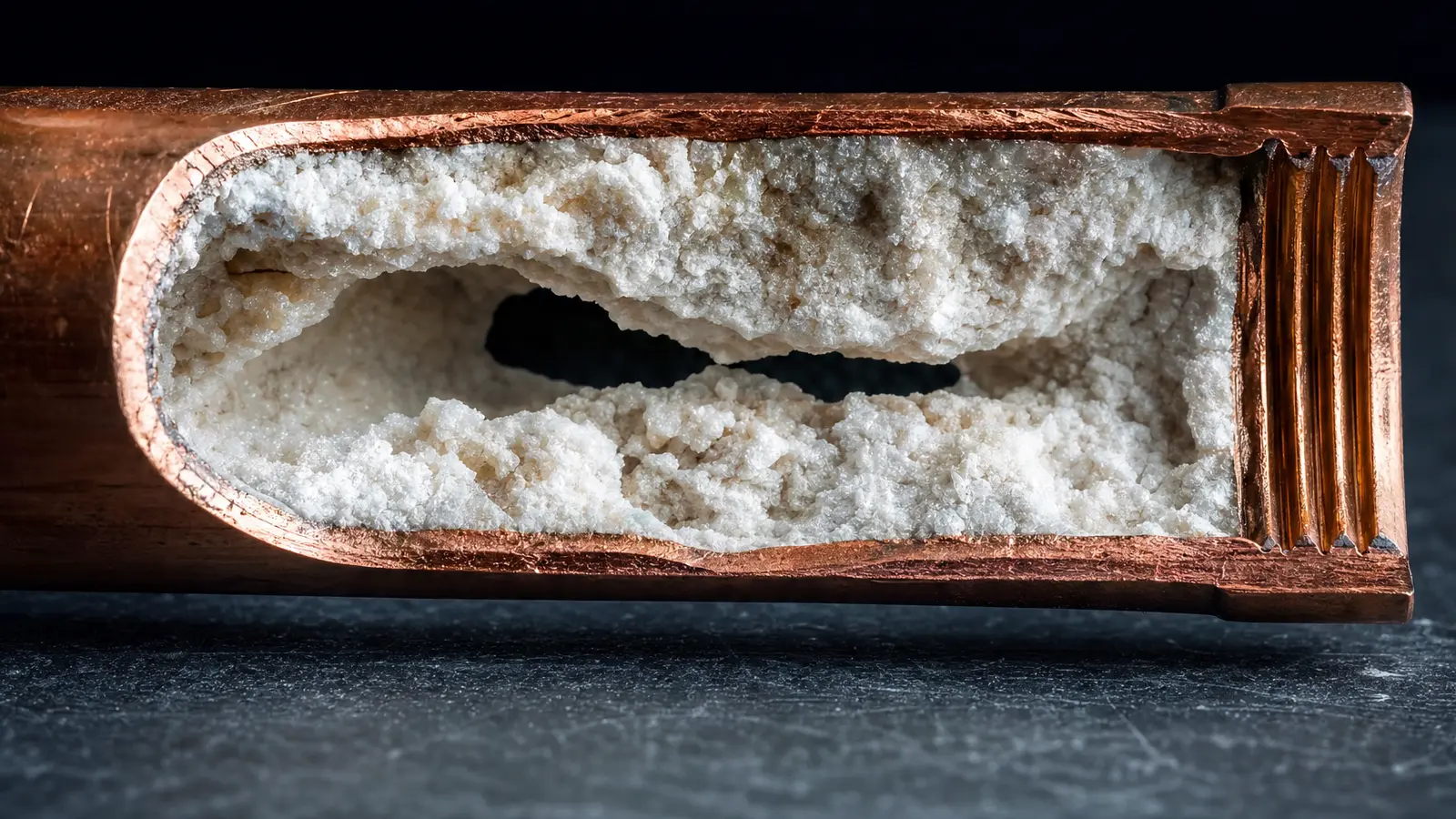
This is what hard water does from the inside.
A standard test measures your exact hardness, so a softener is sized from numbers, not guesswork.
Two different questions, one test.
On a private well, nobody else is checking. The owner is the water company, so sampling, judging the results, and deciding on treatment all sit with the household. The questions that matter are usually the bedrock ones, because Connecticut bedrock supplies arsenic, uranium and radon, and none of the three has a taste, a color, or a smell.
On city water, the utility monitors the system. Your tap is not the system. The questions that matter are usually the ones you can already notice: hardness and scale, a chlorine edge to the taste, staining on fixtures and laundry, or water that smells like rotten eggs. The same standard test answers both versions of the question, because it measures the tap rather than the source.
The differences are laid out post by post in well water versus city water in Connecticut, and what a well water test checks for goes parameter by parameter.
The numbers behind the visit.
Private wells serve Connecticut homes. No utility tests them; testing is the owner's job.
Source: CT DPH, 2020 census basisIn July 2026, nine Connecticut shoreline towns were placed under a mandatory boil water order after E. coli was detected in the public supply. Restaurants closed. Thousands of households were told not to drink their tap water. Nobody knew there was a problem until a sample was tested.
Source: Connecticut Water Co. / news reports, July 2026Municipal water is monitored at the system. Not at your tap.
That is the EPA's enforceable limit for PFOA and PFOS, two PFAS compounds, finalized in 2024. PFAS have been detected in public water supplies across Connecticut, and volatile organic compounds can enter groundwater from fuel, solvents, and industrial sources. Neither has a taste, a color, or a smell you can rely on. A lab report is how you see them.
Source: EPA 2024 PFAS rule · EPA UCMR 5 monitoring / CT DPH private well VOC guidanceSome homes test fine. These numbers describe why testing is the only way to know, not who has a problem.
Where we test.
Bedrock Water is a Connecticut company and tests statewide, with the heaviest week to week coverage in the Farmington Valley and Litchfield County, where drilled bedrock wells are the norm rather than the exception. Appointments run Monday to Saturday, 8 to 6, and evening and Saturday slots exist because most households cannot take a weekday morning off for a water sample.
If you want to see how the state divides between private wells and utility water before you book, the CT Water Map is an interactive read of exactly that. If you would rather just ask, call (203) 833-0038 or write info@bedrock-water.com.
Frequently asked questions
How much does well water testing cost in Connecticut?
The standard test is $299 and covers 22 parameters on one visit through a Connecticut certified lab. Add-on panels are priced per panel: heavy metals +$95, VOCs +$110, pesticides +$210, PFAS +$415. Credited toward your install when you choose Bedrock for your filtration or softener system. Standard test fee credited on installation of a treatment system purchased through Bedrock Water. Add-on panels excluded from credit.
How long do well water test results take?
Field readings happen at your tap during the visit. The certified lab results come back in 3 to 7 days, and we go through the report with you line by line.
What does the standard test check for?
Includes coliform and E. coli bacteria, chlorine, chloride, fluoride, nitrites, nitrates, sulfates, pH, odor, color, turbidity, calcium, magnesium, sodium, total hardness, iron, manganese, copper, radon in water, arsenic, lead, and uranium.
How often should a private well be tested?
CT DPH recommends testing a private well every year for the basic indicators, which include total coliform bacteria, nitrate, nitrite, pH, odor, chloride, hardness, apparent color, sulfate, turbidity, iron and manganese. It recommends lead at least once, arsenic, uranium and radon at least once and ideally every five years, and volatile organic compounds at least once. (Source: CT DPH Publication No. 24, Private Well Testing, May 2019)
Is well water testing required by law in Connecticut?
Testing is required for newly constructed wells under Section 19-13-B101 of the Connecticut Public Health Code. Routine testing of an existing private well is not required. CT DPH notes that water tests done during home purchases are usually required by the bank providing the mortgage rather than by law. (Source: CT DPH Publication No. 24, Private Well Testing, May 2019)
I am on city water. Is a test still worth it?
Municipal water is monitored at the system. Not at your tap. A test tells you what your own faucet delivers, including hardness, taste, odor, and the staining that shows up on fixtures and laundry.
What happens if a result comes back high?
We show you the number, what the applicable action level is, and what treatment addresses it. Bedrock is not tied to one equipment brand, so the recommendation follows the report rather than a product line. Nothing is installed unless a result calls for it.
Your numbers are one visit away.
A certified lab report of your own tap, explained line by line. Call, write, or use the form below.
Book your water test
Or schedule an install if you already know what you need.
Tell us where you are and when works. We’ll confirm within one business day, evenings and Saturdays included.